Pay out globally and facilitate multi-party payments
Platform
Let customers accept payments within your platform
Our Mission
To train aspiring filmmakers in the craft from development through post production so students are not reliant on others to push their film careers forward. We do this without the financial weight of traditional film school and our training is backed by a guarantee that is unmatched in the film education space!
You get proper exposure by controlling the amount of light hitting your camera sensor based on the ISO selected. You expose to ISO similar to choosing a film stock back in the analog days. It doesn't mean you never use ISO on a cinema camera as an exposure tool, but typically you're shooting at a default ISO and using other exposure layers to control light coming in.
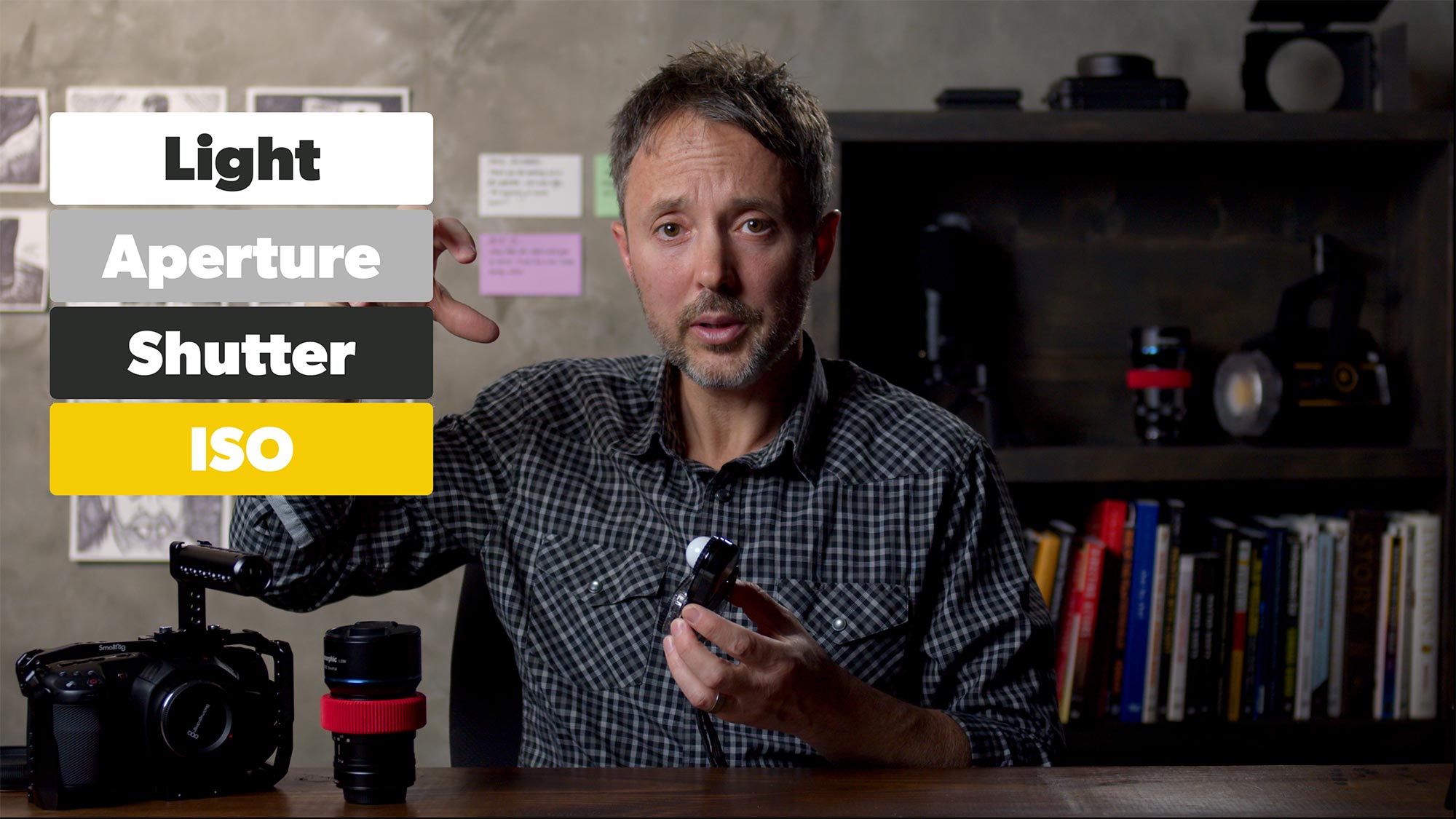
Getting exposure right is critical. Let in too much light and you blow out the highlights, losing detail in the bright areas. Let in too little and the shadows swallow up important information. Either way, the image suffers — you’ll have less information to work with in post, which limits your options when color grading. There are four main exposure layers available to us:
ISO • Shutter Speed • Aperture • Light
However, as you’ll quickly discover, most of these layers are not freely available to filmmakers as exposure tools.
You may have heard of the “Exposure Triangle,” which works well for still photographers. In filmmaking, though, the concept of exposure layers is a much better and more accurate way to think about it. Every layer interacts with light in some way, but several of them also carry other important responsibilities in cinema — which means they can’t always be freely adjusted just for exposure.
Before we dive into the layers themselves, there are two key concepts you need to understand:
1) Ansel Adams Zone System
Ansel Adams, the legendary black-and-white photographer, developed the Zone System — an 11-step scale that runs from pure black (Zone 0) to pure white (Zone X), with nine shades of gray in between. The exact middle of this system is called Middle Gray, which reflects back 18% of the light that hits it. For now, just remember that middle gray is our reference point for “proper” exposure.
2) Dynamic Range
Dynamic range is the ratio between the brightest highlights and the darkest shadows that can be captured in a single image. It is measured in stops of light. The human eye can see roughly 21 stops of dynamic range. Cinema cameras fall well short of that. For example:
The Blackmagic Pocket Cinema Camera captures about 13.1 stops. An ARRI Alexa captures around 14 stops. That’s a $30,000+ difference for just under one extra stop.
So why does dynamic range matter to filmmakers? Imagine shooting a beautiful sunset over a small town. A white billboard catches the last golden rays while the streets below are already falling into deep shadow. The scene has a huge ratio between brights and darks — more stops than your camera can handle. Part of proper exposure is often deciding where you’re willing to compromise. The Exposure Layers
Now let’s go through the four layers and see how (and if) we can actually use them as filmmakers.
Camera ISO
ISO is the foundation layer and at times the most complicated layer to initially understand. But you’ve gotta wrap your head around it so everything else makes sense.
Back in the days of film, ISO dealt with a film stock’s sensitivity to light. Also called the “speed” of the film. A production would decide on a certain film speed based on their creative needs for the scene and then expose to that film negative. A film negative with an ISO rating of 300 is less sensitive to light than film with a speed of 800.
Digital cameras also have an ISO setting that can begin at 50 and go into the thousands, depending on the camera. And similar to film, the ISO setting on a digital camera deals with the camera’s sensitivity to light. Well, sort of.
ISO – What You Need to Know
You can nerd out on ISO like crazy and run down the rabbit hole of analog and digital gain, etc. But for us aspiring directors, it’s overkill. Here’s what you need to know:
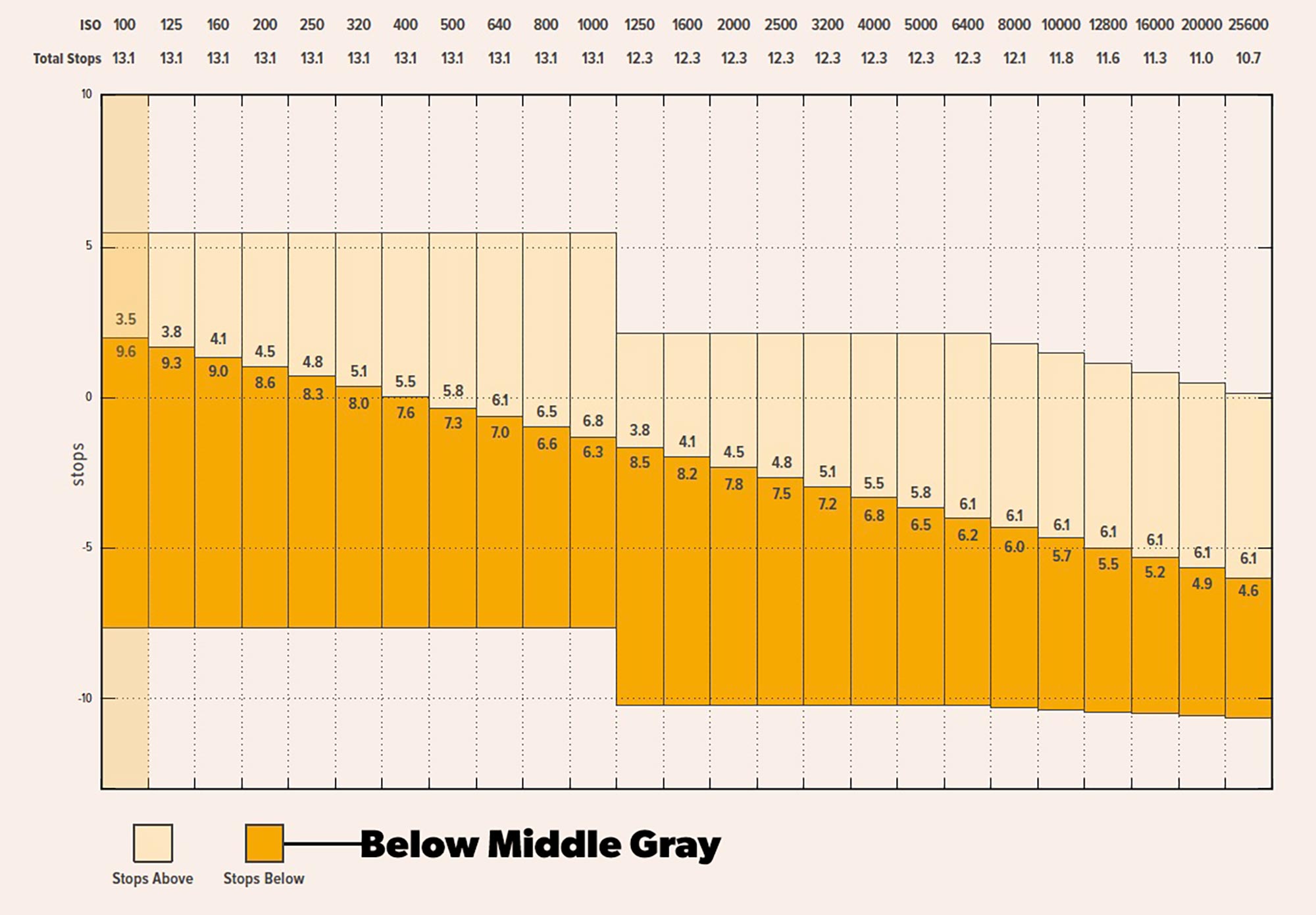
Let’s jump back to the concept of middle gray, but instead of the eleven zone-system we’ll reference the full dynamic range of a camera. If my camera has 13.1 stops of dynamic range, I have a certain amount of stops above and below middle gray. ISO controls this.
See the graph below from Blackmagic Design. Based on the ISO setting for their Pocket Cinema Camera you’re moving the camera’s dynamic range of exposure above or below middle gray.
Are you tracking with me?
Cinema cameras have what they call a “native” ISO which is the camera manufacturer’s recommended ISO setting for the best range above and below middle gray (given proper exposure). Essentially, the best image for that camera. Because when you go up or down on ISO you might be compromising in some way. The native ISO on a Blackmagic Design Cinema Camera 6K is ISO 400. This gives a theoretical 5.5 stops above middle gray and 7.6 stops below middle gray of image detail.
What do you think more stops below middle gray does? Captures more details in the shadows.
So great right? You have a dim scene on a film noir movie and you want details in the shadows. So just drop the ISO and you’re done! Not exactly. Dropping my ISO down to 100 doesn’t work any miracles. I still have to expose to this setting — just like the film days. Dropping down to ISO 100 will give me more details in the shadows, but only if I exposure correctly.
So with that, let’s move up to the next exposure layer — shutter speed.
Shutter Speed
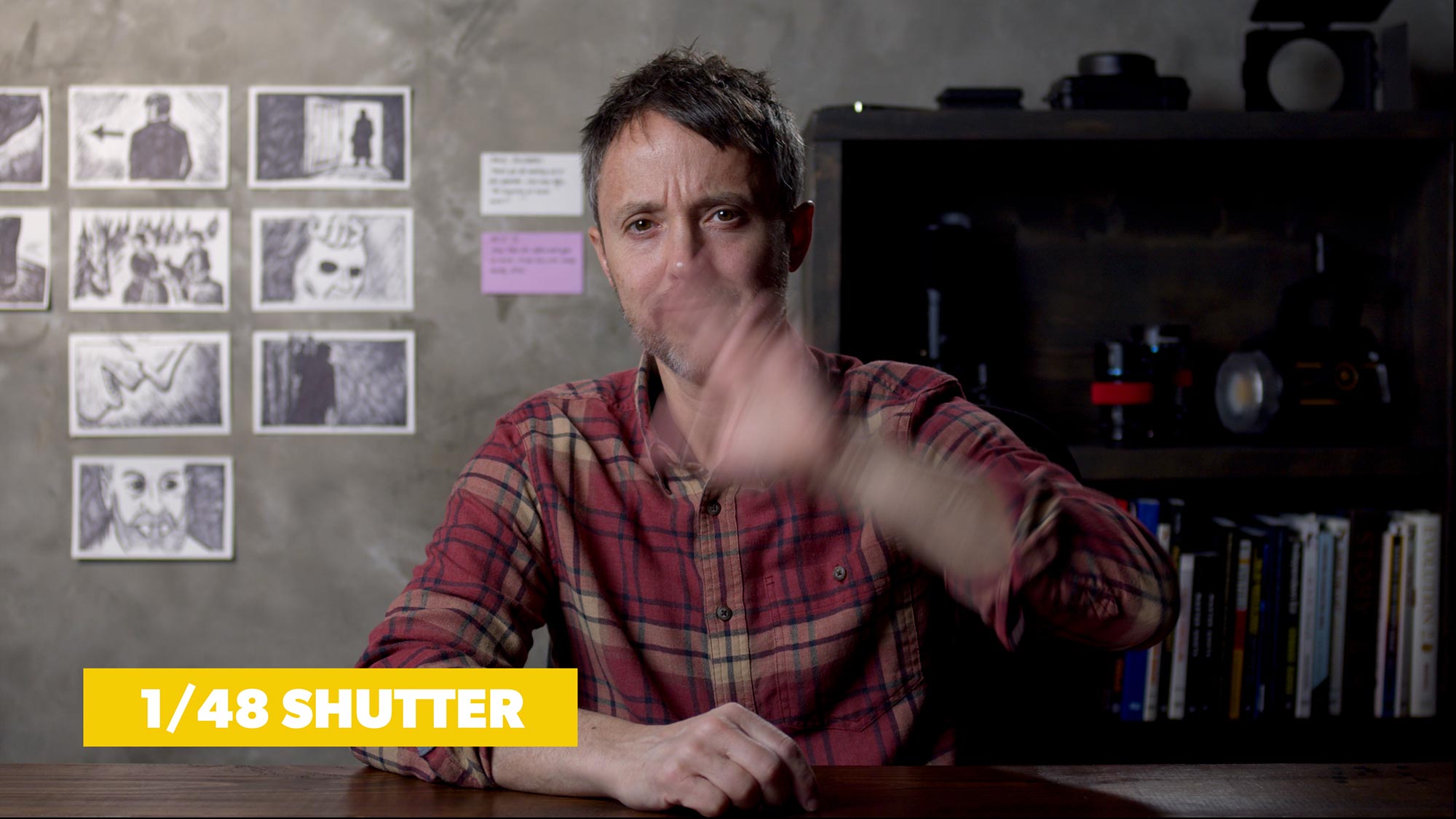
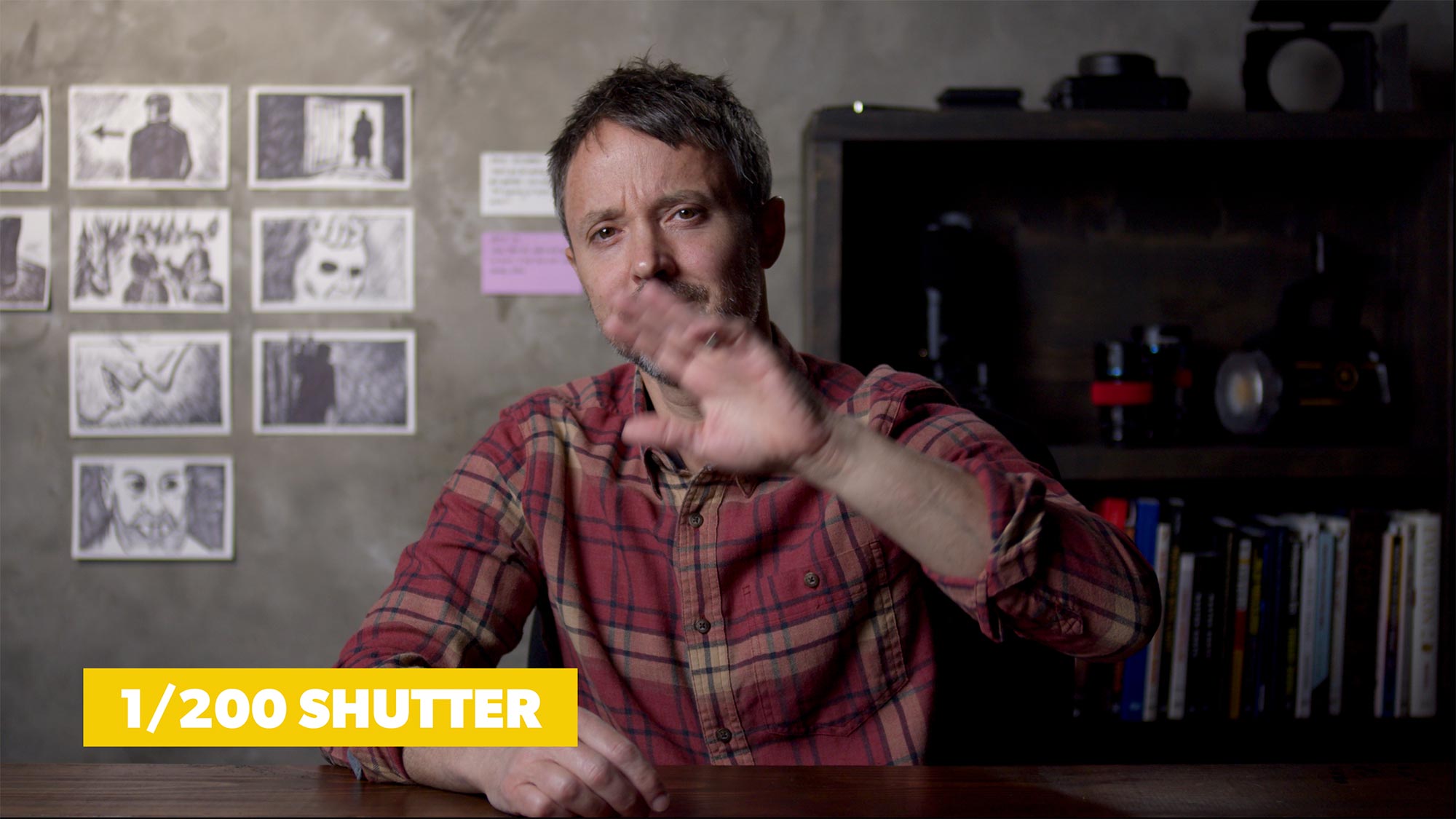
The camera shutter controls how long the sensor is exposed to light. Shutter speed is measured in parts of a second. A 1/200 shutter is open for one two hundredth of a second and would be considered a “fast” shutter. A fast shutter cuts down on motion blur and produces a crisper image. A slow shutter introduces motion blur.
Here are two examples of someone waving their hand up and down and what a still frame of the movement looks like with two different shutter speeds:
Although the shutter controls how long a sensor is exposed to light, it’s not an exposure layer we can use to actually control exposure. Why?
Cinematic motion blur.
We often shoot narrative film at 24 frames a second for a cinematic look and feel. But it’s not just about 24 frames. There’s another part — an associated cinematic motion blur defined by the 180 degree rule. Film cameras used to have rotating shutters that exposed each frame of film to light based on a degree of the shutter’s opening. And the shutter angle was set to 180 degrees.
Audiences now subconsciously associate the look and feel of 24 frames and the resulting blur from a 180 degree shutter with movies. To achieve the same motion blur with digital cameras you multiply your frame rate by 2. When shooting 24 frames the math is:
24 x 2 = 48
Some cameras (like Blackmagic Design cameras) allow you to set the shutter by parts of a second or by angle. This doesn’t change the mechanics of the camera, but simply allows you to do it either way. The advantage of angle is that you’re guaranteed the right motion blur regardless of frame rate.
So even though shutter speed technically does affect light hitting your camera’s sensor which affects exposure, it can’t be used as an exposure tool due to the 180 degree rule. Make sense? What’s next?
Aperture
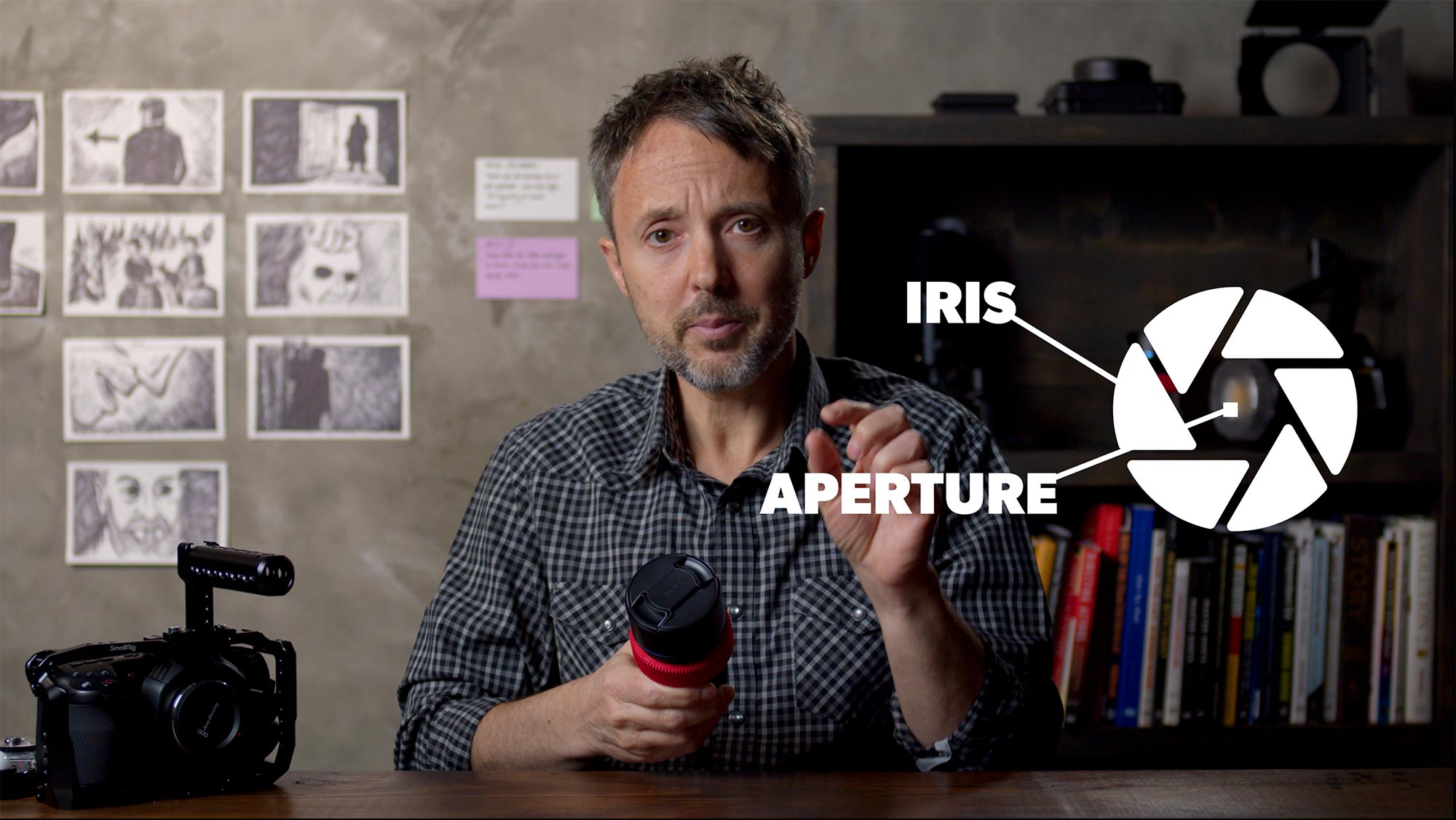
For aperture we leave the camera and move into the lens itself. A lens has an entrance pupil similar to the human eye. The entrance pupil opens to allow light in and closes to cut light out. The mechanics that open and close is called the iris, and the actual opening itself is aperture.
Aperture is measured in stops of light referred to as focal stops or F-STOPS on the lens. The lower the F-STOP the wider the aperture. If you ever hear someone say “I’m shooting wide open” it means they’re at the lowest F-STOP value for that particular lens. This means they’re letting in as much light as possible. Nice! We finally have an exposure layer that helps control exposure.
Actually, not so fast. What else does aperture affect? Depth of field.
Opening and closing the IRIS on a camera mimics a distance change to your subject which affects your depth of field. The lower your F-STOP the shallower your depth of field. If you’re shooting a scene with a couple actors in it, your minimum F-STOP should be 5.6 or greater. Otherwise you’ll have them falling out of focus way too easy. So what does this mean?
It means yet another exposure layer not always available to us for getting exposure! Crazy right? So what’s next?
Light & Example
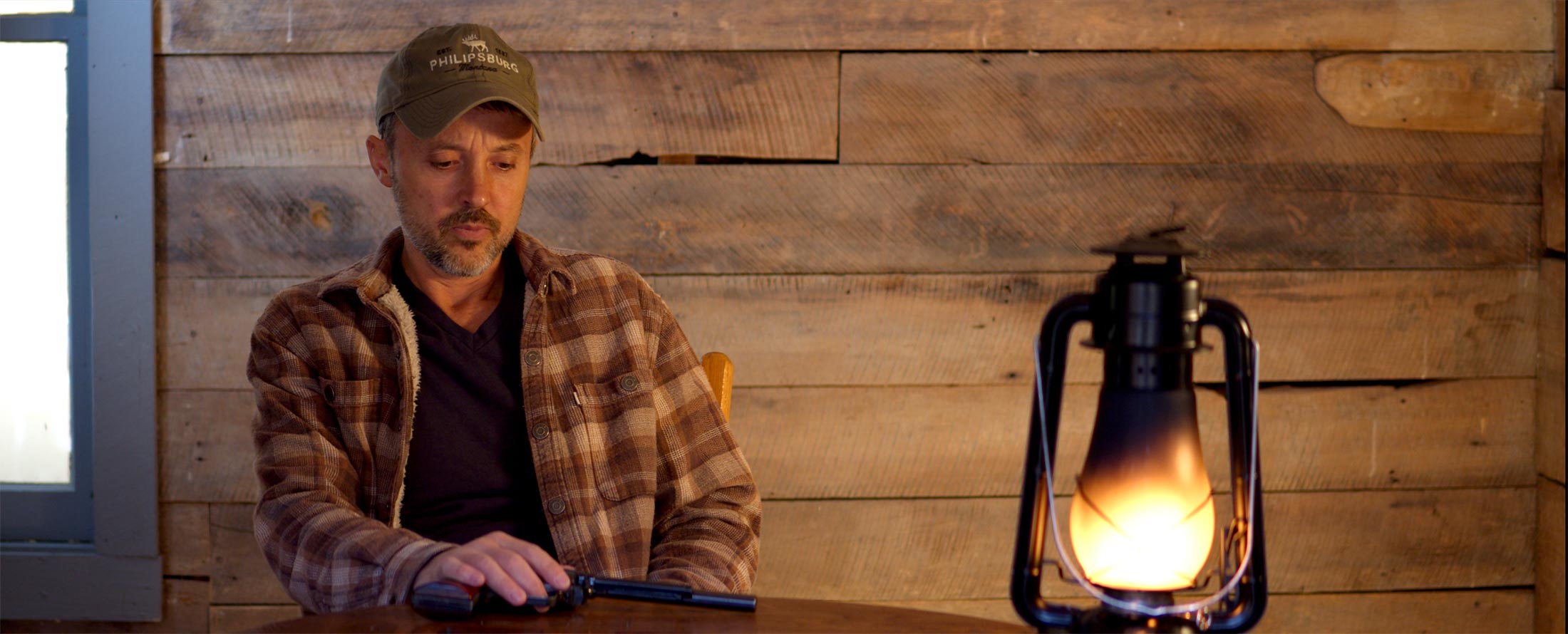
Our final exposure layer is light, and light is often the only layer available to us as filmmakers that directly affects exposure. This is paramount to understand. To drive these points home, let’s say the image below is our set. After we find our motivated light and setup our key, fill and background lights (at a minimum) to dial in the mood and add depth we’re ready to work through our exposure layers. To do that we grab a light meter and begin with the foundation:
ISO
Let’s say we’re shooing on a Pocket 4K. For ISO we’ll go with the native ISO of 400 for the Blackmagic Pocket camera. This will give us a good balance of dynamic range above and below middle gray. If we can get exposure at the native ISO, unless we have a specific reason otherwise.
SHUTTER SPEED
We’re shooting 24 frames a second so our shutter is set to 1/48 or 180 degrees.
APERTURE
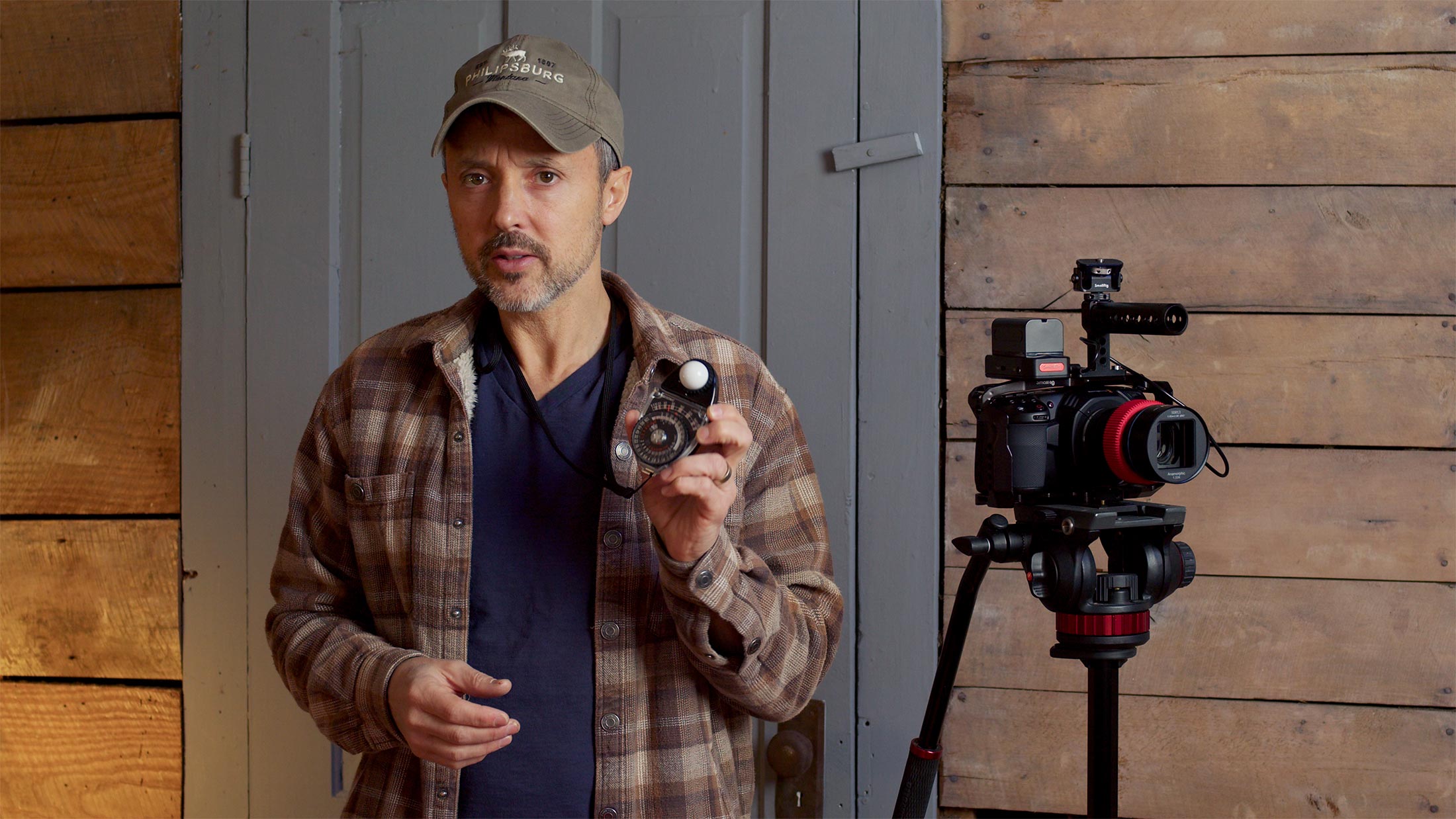
I’ll grab an incident light meter and take a reading. It tells me the current lighting is 40 foot candles.
I’m shooting 24 frames so this has me at an F-STOP of 2.8 for proper exposure (according to the light meter). So if I set my lens to 2.8 that’s it. I’m done! I’ll have proper exposure.
Easy right?
So even though layers 1 and 2 weren’t used for exposure specifically, layer 3 allowed us to dial it in since it’s one actor and not a moving shot.
But what if this scene had 2 or 3 actors? As mentioned we need to be at an F-STOP of at least 5.6 or higher for a proper depth of field. If I move the light meter to the desired 5.6 F-STOP it will indicate my foot candles rating needs to hit 160. Quite a bit brighter!
The only way to get proper exposure in this scenario would be to modify our final layer: Lighting on set. We’d need to go to our key light and increase it until we get a light reading of 160. And we’d also have to adjust fill and background lights to keep the balanced look that we have.
Then and only then would I have proper exposure at an aperture of 5.6.
Make sense? Let’s take another example:
OUTDOORS: Too Much Light
Let’s assume we’re outside on a cloudy day. We’re again shooting on the Blackmagic Pocket Cinema Camera using a Sirui anamorphic lens with an F-STOP range of 2.2 to 16.
We’ll stick with the native ISO on the camera and set the shutter to 1/48. Next we’ll take a light reading. Let’s say it says it tells us we need to be at an F-STOP of 18 to get proper exposure. We can’t close down that much on this lens. We need to operate at our fourth layer…but we can’t control the sun.
What to do?
A large silk could be used to remove stops of light. Or an easier method would be to use an ND filter. “Sun glasses” for your camera. ND filters can adapt to a lens while some cinema cameras have internal ND filters. Let’s look at a final example:
Controlled Set: Shadow Details
Let’s say you’re shooting a scene for a thriller that takes place in an old house at night. You want to capture a lot of details in the shadows. This means we want to move our camera’s dynamic range further below middle gray.
The obvious thought is to drop our ISO down to 100 (see the chart from Black Magic Design below). An ISO of 100 delivers the most stops of exposure detail below middle gray for the Pocket 4K. But here’s the thing: As stated above, setting your camera to ISO 100 isn’t a miracle worker.
For this example let’s say I need a decent depth of field so my actor doesn’t fall out of focus. So we’ll set our F-STOP to 5.6. Now if I set my lighter meter to an ISO of 100 and an aperture of 5.6, the light meter tells me I need to be at…wait for it:
640 foot candles.
Whoa! That’s an insane amount of light. Once again we’re relying on the fourth exposure layer to get proper exposure based on the foundation we are exposing to, which is ISO 100. Telling the camera to be at ISO 100 is only a dynamic range positioning tool, not an exposure tool.
So what’s our main takeaway as filmmakers?
1) There are four main exposure layers: ISO, Shutter Speed, Aperture and Light.
2) ISO is typically not an exposure tool. It’s more of a dynamic range selector.
3) Our Shutter must be at a multiple of 2 of our frame rate.
4) Aperture can be used for exposure, but may be limited by depth of field requirements.
5) Often our final layer, the light layer, is how we obtain proper exposure. And the tools at this layer are of course lights, ND filters, silks, scrims, etc.
Once you truly understand exposure and have a quality light meter, dialing it in is no longer a gamble.
Do You Want To Direct?
We guide emerging filmmakers around the pitfalls of conventional film school. We teach you the craft and prepare you for what's next. All backed by the finest guarantee in the film education space.
Do you want to make movies?
We guide emerging filmmakers around the pitfalls of conventional film school. We empower them to master the craft and seize control of their filmmaking career.
There's nothing else quite like it. Enroll today or find out more below:



 SaaS
SaaS Manage recurring bills and subscriptions
 Marketplaces
 Platform